
Frequently asked questions about professional supervision
What is Professional Supervision?
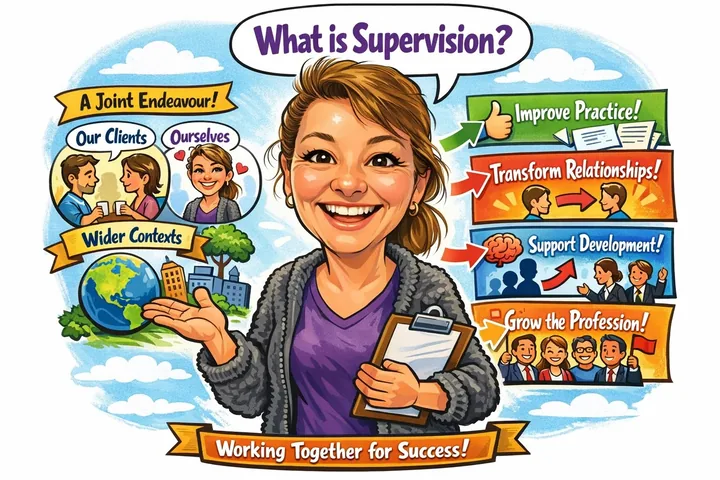
Professional Supervision is an intentional, regular and confidential space to connect, reflect and respond to what is happening in your work.

The Australasian Association of Supervision (AAOS) describes supervision as:
“A contractual, relational, collaborative process, which facilitates the ethical and professional practice of the supervisee.”
Supervision provides a planned, intentional and boundaried space where you can step away from the demands of your role and reflect on your practice with someone trained to walk alongside you.
It is a safe place to have those conversations out loud that you might usually only have in your head.
Together, we can create space for learning and growth, clarity and perspective, honesty and courage, all of which can benefit you, your work and the people you serve.
What happens in a supervision session?
There is no single formula for supervision. Each session is shaped around you, your role, what you are experiencing and what you hope to gain from the time together.
You may arrive with a particular situation, relationship, ethical dilemma or challenge you want to explore. Or you may simply know that something doesn’t feel quite right and want space to discover what is beneath it.
Together, we might explore questions such as:
- What is going on?
- How can this be changed or approached differently?
- What does this really mean?
- Who am I in this situation?
- How am I responding, and why?
- What might I be missing?
- How could I look at this from a different perspective?
- What might I take forward from this experience?
Supervision allows us to look at your work from different angles, considering the person, the practice, the relationships, the context and the wider systems in which you work.
If you work within a faith-based context, there may also be opportunities for theological reflection, where appropriate to your role and goals.
Why pursue Professional Supervision?
Supervision is more than simply having someone to talk to. It provides a structured environment for reflection, accountability, learning and professional growth.
It can help you:
- reflect on your experiences and learn from them
- identify your values and understand how they shape your practice
- develop greater self-awareness
- consider situations from different perspectives
- navigate ethical dilemmas and complex situations
- strengthen professional boundaries
- identify learning and development needs
- build resilience and reduce the risk of burnout
- recognise and respond to stress
- explore the interaction between personal, professional and spiritual dimensions of your work
- consider organisational, cultural and systemic influences
- strengthen professional practice and duty of care
- develop strategies for future situations
- maintain values-based practice consistent with professional standards and best practice.
When practitioners are supported to reflect well, the benefits can extend beyond the individual to the health of teams, organisations and the people they serve.
Is Professional Supervision the same as coaching or mentoring?
No. While coaching, mentoring, counselling and spiritual direction can all have valuable roles, they have different purposes and focuses.
Professional Supervision is not:
- counselling
- spiritual direction
- coaching
- mentoring
- line management.
Elements of these approaches may naturally arise within a supervision conversation, but they are not the primary focus.
One of the distinctive features of Professional Supervision is that while your wellbeing and professional development are important, supervision also keeps in view the needs of the “absent other”: the people you serve through your work.
If it becomes clear that you would benefit from a more specialised form of support, this can be discussed and an appropriate external referral may be recommended.
How often do I need supervision?
The frequency of supervision can be discussed during your initial consultation and will depend on your role, goals, professional requirements and available resources.
For many practitioners, a session approximately every 5 to 6 weeks over a 12-month period provides a helpful rhythm for ongoing reflection and professional development.

More or less frequent sessions can be arranged where appropriate.
Why are organisations recommending Professional Supervision?
Professional Supervision is increasingly recognised as an important part of healthy, ethical and sustainable professional practice.
It provides practitioners with:
- a non-judgemental space for accountability
- support and reflection
- an opportunity to debrief appropriately
- a rich environment for learning
- space to explore ethical and professional dilemmas
- assistance in identifying learning and development needs
- support to maintain professional standards and duty of care
- opportunities to access relevant resources and develop practical strategies.
For people working in religious and pastoral ministry, the importance of professional supervision has also been recognised in the 2017 Final Report of the Royal Commission into Institutional Responses to Child Sexual Abuse.
Recommendation 16.45 stated that religious institutions should ensure that people in religious or pastoral ministry have professional supervision with a trained professional or pastoral supervisor who has a degree of independence from the institution in which they serve.
A space to pause, reflect and grow
You don’t have to have everything figured out before you come to supervision.
Sometimes you may come with a clear question. Sometimes you may simply need space to stop, breathe and make sense of what is happening.
Supervision is a space to pause the doing, make room for reflection, and discover what might be emerging beneath the surface.
Together, we can create a refining space where you can connect, reflect and respond, strengthening your practice while caring for the person behind the role.
Enquire about supervision sessions
Complete the enquiry form and I will follow up with you by phone or email to discuss your supervision needs and arrange a suitable time for your session.
Once your session is confirmed, you will receive a booking confirmation and Microsoft Teams meeting details.
Name and email are needed so I can reply.
